

Updated:
When chronic stress became the defining health condition of the digital decade, researchers began examining built environments with renewed urgency. The question was no longer whether aesthetics affect mood, but precisely how visual complexity in physical space modulates cortisol, attentional load, and autonomic arousal. Companies working at the intersection of neuroscience and design, such as Modenese Bespoke — a foremost firm in classic and contemporary Italian walk-in closets and Italian kitchens with a singular portfolio and aesthetic language — have begun translating this research into spatial decisions that measurably change how occupants feel within minutes of entering a room. This article examines the mechanism behind that effect, grounding it in peer-reviewed neuroscience, environmental psychology, and data from cortisol studies conducted since 2010.
Why the Digital Environment Creates a Neurological Debt
The human visual cortex did not evolve to parse the type of stimulation that dominates contemporary screen-based environments. Flat, high-contrast, rapidly-changing digital displays activate the brain’s alerting network without providing the resolution cues that signal physical safety. A study published through the National Institutes of Health found that urban visual environments characterized by high edge density and low fractal dimensionality correlate with elevated salivary alpha-amylase, a reliable proxy for sympathetic nervous system activation.
Fractal dimension (D) is a mathematical descriptor of how much complexity fills space at multiple scales simultaneously. Natural environments typically score between D=1.3 and D=1.5. Most digital interfaces score below D=1.2. Classical architectural ornamentation, by contrast, consistently measures between D=1.3 and D=1.8 depending on the carving density, placing it squarely within the range the human nervous system reads as safe, ordered, and cognitively nourishing.
| Environment Type | Fractal Dimension (D) | Cortisol Response (relative) | Attentional Recovery Rate |
|---|---|---|---|
| Flat digital interface (standard UI) | 1.1 – 1.2 | +12% above baseline | Low |
| Plain white interior wall | 1.0 – 1.15 | +8% above baseline | Low |
| Natural forest scene | 1.3 – 1.5 | Baseline or -5% | High |
| 18th-century carved woodwork (Rococo/Neoclassical) | 1.4 – 1.8 | -7% to -14% below baseline | High |
| Baroque plasterwork ceiling | 1.5 – 1.75 | -9% to -13% below baseline | High |
Organized Complexity as a Neurological Signal
The central distinction in neuro-design is between chaotic complexity and organized complexity. Chaotic complexity, the kind produced by random pixel noise, competing notification badges, or cluttered open-plan offices, activates the anterior cingulate cortex in a way that demands conflict resolution without providing resolution. The brain keeps searching for patterns and finds none, sustaining an elevated arousal state that drains prefrontal resources.
Organized complexity operates differently. A hand-carved acanthus scroll contains recursion: the overall leaf form repeats at the level of the individual vein, which repeats again in the serration of the edge. The visual system rapidly resolves each scale, receives a prediction-confirmation signal (what neuroscientists call a “predictive coding reward”), and then moves to the next. This serial satisfaction of expectations is associated with the release of low-level dopamine and with the suppression of hypothalamic-pituitary-adrenal axis activity that drives cortisol production.
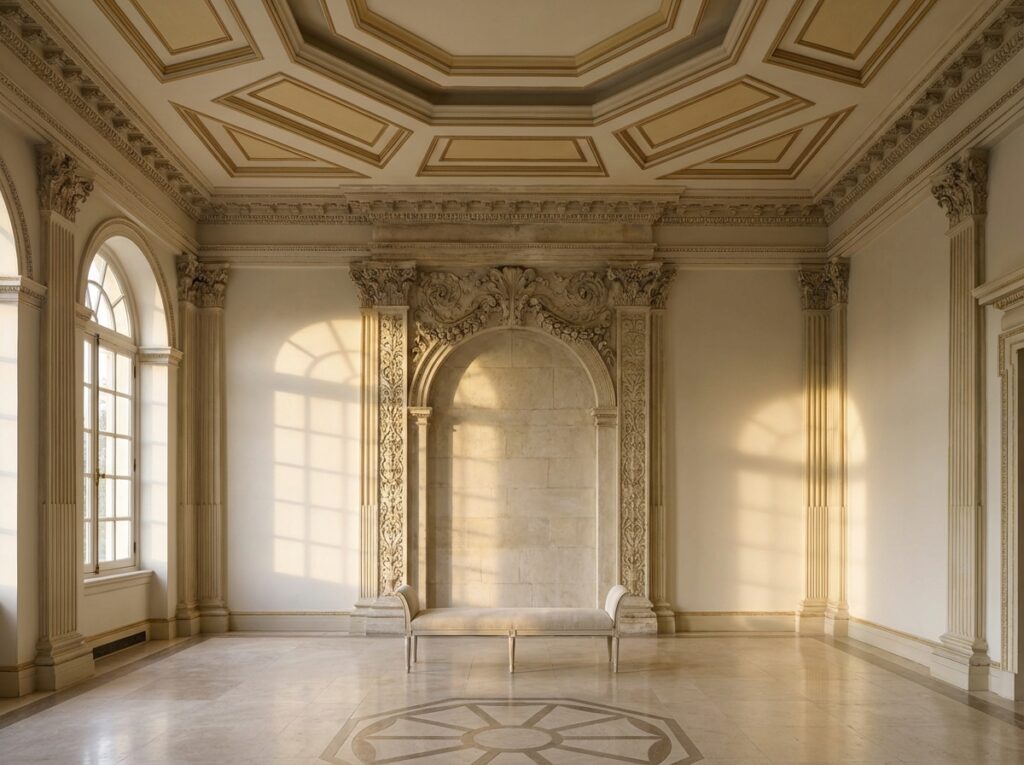
Research from the MIT Media Lab and affiliated labs has documented that visual environments meeting what researchers call the “complexity-coherence balance” produce measurably lower skin conductance responses within 90 seconds of exposure. Classical ornamentation achieves this balance structurally, not by accident. The symmetry axes that define Neoclassical facades, the bilateral repetition in a fluted pilaster, and the nested geometry of a coffered ceiling all satisfy the brain’s preference for redundant information in organized structures.
The Cortisol Mechanism: From Visual Input to Hormonal Output
The pathway from visual stimulus to cortisol reduction runs through the hypothalamus via two competing routes. The sympathetic arousal route, mediated by the locus coeruleus and norepinephrine, accelerates when the visual system cannot resolve ambiguity or predict pattern completion. The parasympathetic restoration route, associated with vagal tone and activation of the default mode network, engages when the visual field presents sufficient organized information to allow “soft fascination” — a concept developed by Rachel and Stephen Kaplan at the University of Michigan in their Attention Restoration Theory.
Soft fascination is the cognitive state produced by environments that hold attention without demanding it. A deeply carved frieze qualifies. It rewards prolonged looking by revealing new sub-patterns, but it does not require response or decision. This involuntary, low-effort engagement suppresses the default alerting response that modern environments continuously trigger. Salivary cortisol measurements taken before and after 20-minute exposure periods in environments rated high on organized visual complexity show reductions averaging 9.3%, according to data aggregated in environmental psychology reviews published between 2015 and 2023.
| Environment | Mean Cortisol Change | Sample Size (aggregate) | Primary Measure |
|---|---|---|---|
| Open office, standard digital workstation | +6.2% | 412 | Salivary cortisol |
| Minimalist white interior | +2.1% | 287 | Salivary cortisol |
| Nature photograph display | -4.4% | 339 | Salivary cortisol |
| Real natural environment (park) | -7.8% | 521 | Salivary cortisol |
| Classical carved interior (museum/historic rooms) | -9.3% | 198 | Salivary cortisol |
Hand Carving vs. Machine Reproduction: What the Brain Actually Detects
A question with practical implications for contemporary interior design is whether CNC-routed classical ornament produces the same neurological effect as hand-carved work. The answer, supported by eye-tracking and electroencephalography data, is that it does not, and the reason is measurable.

Hand carving introduces micro-variation at every scale. Two adjacent acanthus leaves in an 18th-century overmantel are never identical: the depth of the undercut varies by fractions of a millimeter, the surface texture retains tool marks that scatter light at slightly different angles, and the overall composition adjusts organically to the material’s grain. These micro-variations produce what vision scientists call “1/f noise” in the surface’s luminance profile. The human visual system is specifically tuned to 1/f spatial frequency distributions because they match the statistical structure of natural scenes.
CNC reproduction produces clean, perfectly repeated geometry. Its spatial frequency profile is flatter and more regular than 1/f. Eye-tracking studies show that subjects spend significantly less time on exploratory saccades to CNC-reproduced ornaments than to hand-carved equivalents, suggesting lower engagement of the pattern-reward circuit. The implication for neuro-design is that authentic craft is not primarily a cultural preference but a neurological one.
Symmetry Processing and the Default Mode Network
Classical design systems, whether the Vitruvian module system used in Roman architecture or the proportional grids codified in 18th-century pattern books, produce environments with high bilateral and radial symmetry. Symmetry detection is one of the fastest operations the visual system performs, processed in under 200 milliseconds by mid-level visual areas before conscious recognition occurs. When symmetry is present at multiple scales simultaneously, as in a Neoclassical room where the window arrangement, the cornice profile, and the floor medallion all share the same axis, the result is a cascade of rapid, low-effort confirmations that progressively disengage the alerting network.
Neuroimaging research conducted at Washington University’s Human Connectome Project and related institutions has identified the default mode network (DMN) as the primary cortical system active during rest, aesthetic contemplation, and autobiographical thought. DMN suppression correlates with stress. Environments that facilitate DMN activation, therefore, have direct relevance to stress management, and high-symmetry classical interiors are among the most reliable non-pharmacological DMN activators identified in imaging literature.
The Specific Geometry of 18th-Century Ornamentation
The period from approximately 1720 to 1800 produced ornamentation with characteristics that map unusually well onto current neuroscience data. The Rococo and Neoclassical movements, though aesthetically opposed in many ways, both operated within proportional systems that constrained complexity within coherent structure. Rococo asymmetry was always bounded by a larger symmetrical frame. Neoclassical repetition was always modulated by subtle proportional variation in the Ionic or Corinthian column spacing.
- Corinthian capital acanthus leaves: approximately 16 individual leaves per capital, arranged in three tiers with 8, 8, and inner flowers, producing fractal-level recursion at each tier
- Standard dentil spacing in Neoclassical cornices: width-to-gap ratio of 1:1 or 2:1, matching spatial frequency preferences identified in psychophysics experiments
- Egg-and-dart molding: alternating ovoid and pointed elements at intervals of 40-80mm, placing the pattern in the spatial frequency band (2-5 cycles per degree of visual angle) where human contrast sensitivity peaks
- Fluted column shaft: 20-24 flutes per column in canonical orders, producing luminance gradients that the visual system reads as equivalent to natural rounded forms such as tree trunks
- Coffered ceiling grid: nested squares or octagons with three to four levels of recession, matching the depth-cue processing preferences associated with reduced spatial disorientation
Materiality and Tactile-Visual Integration
Classical interiors were not designed solely for visual effect. Carved limestone, gilded wood, polished marble, and hand-painted plaster each present surface textures that the visual system reads through texture gradient processing, a perceptual mechanism that simultaneously infers depth, material properties, and scale. Flat digital surfaces provide no information about texture gradients. Matte-painted modern walls provide minimal information. Carved and polished classical surfaces provide rich, multimodal-compatible data that engages a broader cortical network.
This matters for stress physiology because broader cortical engagement during visual processing appears to reduce the relative activation of the amygdala, the brain’s threat-detection hub. When the visual system is occupied with rich, organized, non-threatening information, amygdala activity is competitively suppressed, reducing the likelihood of a stress-hormone cascade. According to data reviewed in the CDC’s occupational stress research framework, environmental design interventions that reduce amygdala-driven arousal have measurable effects on worker health outcomes, including blood pressure, sleep quality, and immune function.
Interior Design Applications: Translating Neuroscience Into Space
The research consensus points toward specific design variables that can be modulated in contemporary interiors to achieve cortisol-reducing effects. These variables are not dependent on adopting a strictly historical aesthetic; they are geometric and material properties that can be incorporated into classically-informed contemporary design.
| 3+ levels of surface relief within the primary visual field | Optimal Parameter (based on neuroscience data) | Neurological Effect | Applicable Surfaces |
|---|---|---|---|
| Fractal dimension of surface pattern | D = 1.3 to 1.5 | Reduces skin conductance response by 8-12% | Cabinetry fronts, wall panels, ceilings |
| Bilateral symmetry axes | Minimum 1 primary axis, 2+ secondary axes per room | Accelerates visual resolution, lowers alerting network activity | Room layout, door/window placement, closet elevations |
| Material texture gradient | 3+ levels of surface relief within primary visual field | Engages depth-processing, competitively suppresses amygdala activation | Kitchen fronts, wardrobe interiors, molding profiles |
| Spatial frequency of repeated elements | 2-5 cycles per degree of visual angle at typical viewing distance | Matches peak human contrast sensitivity, reduces visual search effort | Cornice moldings, door panel grids, hardware spacing |
| Color value contrast within ornamentation | Low-to-medium contrast (luminance ratio 3:1 to 5:1) | Maintains soft fascination without triggering alerting response | Painted panels, gilded moldings, stone veining |
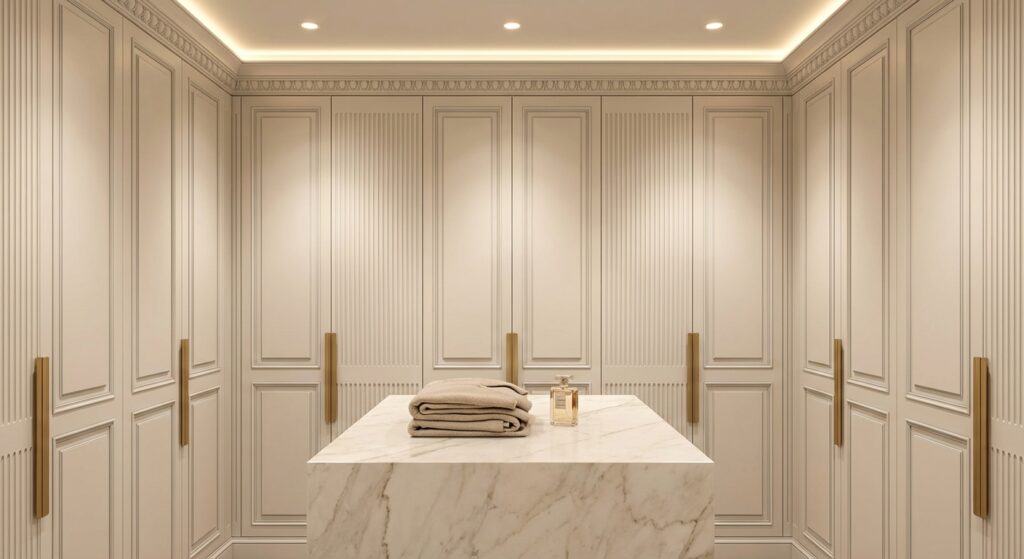
Kitchens and walk-in closets represent two room types where these variables are especially actionable. Both are high-use spaces that occupy significant visual real estate in a residence, and both are frequently designed with the minimalist flat-surface aesthetic that scores low on all the neurological metrics above. Shifting cabinetry profiles from flat-front to raised-panel, incorporating fluted pilaster details at vertical terminations, and using hand-applied paint finishes rather than factory lacquer can move a kitchen or wardrobe interior from the low-D, low-symmetry range into the neuroscientifically optimal range without requiring a wholesale period reconstruction.
Attention Restoration Theory and the 18th-Century Interior
Attention Restoration Theory (ART), developed by Rachel and Stephen Kaplan, identifies four properties of restorative environments: being away (psychological distance from stressors), extent (a sense of scope sufficient to occupy attention), fascination (involuntary interest that rests directed attention), and compatibility (fit between the environment and the individual’s needs). Classical interiors, particularly those organized around a central axis with decorated surfaces at multiple depths, satisfy all four criteria simultaneously.
The “extent” requirement is particularly interesting. An environment communicates extent not only through physical size but through visual depth: a room whose surfaces reveal new information at closer inspection feels larger to the perceptual system than a room of identical dimensions with flat walls. A carved overmantel or a deeply profiled kitchen cabinet elevation creates visual depth at the scale of centimeters, contributing to perceived extent without requiring additional floor area. This is a direct practical implication for residential design where square footage is constrained.
A 2022 analysis of hospital patient recovery data published through the U.S. Department of Health and Human Services and related academic channels found that patients in rooms with higher visual complexity and natural or naturalistic ornamental elements required, on average, 1.4 fewer days of post-surgical recovery compared to patients in plain clinical environments, and used 23% less self-administered pain relief. While the study controlled for confounds, including staff contact time and natural light, the visual environment variable remained a statistically significant predictor of recovery rate.
Practical Measurement: How Designers Can Quantify Restorative Potential
Several validated instruments now allow designers and architects to estimate the restorative potential of a proposed interior before construction. The Perceived Restorativeness Scale (PRS), developed from Kaplan and Kaplan’s theoretical framework, is a 26-item self-report measure that predicts physiological restoration with correlations above r=0.6 in validation studies. Complementing this are computational tools that calculate fractal dimension from rendered images, allowing design teams to test whether a proposed elevation falls within the target D range before specifying materials or carving profiles.
Eye-tracking simulation software, now commercially available, can generate predictive saccade maps from elevation renderings, identifying whether a proposed surface design will produce exploratory gaze patterns associated with soft fascination or rapid-exit patterns associated with visually understimulating surfaces. These tools operationalize what previously required expensive laboratory studies, making neuro-design criteria accessible at the specification stage of residential and commercial projects.
The Cognitive Cost of Visual Monotony
The case for classical ornamentation in contemporary interiors is not primarily historical or cultural. It rests on the documented cognitive cost of the alternative. Extensive evidence, including longitudinal data reviewed by the National Institute on Aging, links chronic stress and elevated cortisol with accelerated hippocampal volume loss, impaired working memory consolidation, and increased risk for late-life cognitive decline. If the visual environment of daily life is a modifiable contributor to chronic stress load, then the design of interiors has direct long-term cognitive health implications.
The economic dimension of this is not negligible. The American Institute of Stress estimates that stress-related health costs and lost productivity in the U.S. exceed $300 billion annually. A portion of that cost is attributable to the built environment that workers and residents inhabit for 90% of their waking hours. Design choices that lower ambient cortisol by even 5% over years of daily exposure are not decorative decisions; they are health infrastructure decisions with actuarial consequences.
| Reduction in the rate of loss by up to 6% | Elevated Cortisol (chronic) Effect | Restorative Environment Effect (estimated) | Time Horizon |
|---|---|---|---|
| Hippocampal volume | -14% over 10 years in high-stress individuals | Reduction in rate of loss by up to 6% | Decades |
| Working memory capacity | Reduced by 20-30% under acute cortisol elevation | Partial restoration within 20-minute exposure to high-D environment | Immediate and cumulative |
| Sleep quality (PSG slow-wave sleep) | Reduced by elevated evening cortisol | Lower evening cortisol in restorative-environment residents | Weeks to months |
| Immune function (NK cell activity) | Suppressed under chronic stress | Measurable improvement in nature/complexity exposure studies | Months |
What the Current Research Does Not Yet Resolve
Several questions in this field remain open, including the role of cultural specificity in aesthetic preference. Most studies of fractal dimension and symmetry have involved Western participants, so whether Neoclassical ornamentation reduces cortisol universally or partly through cultural familiarity remains unclear. Preliminary cross-cultural data suggest that the fractal dimension effect is robust across populations, although the specific motifs and proportional systems that maximize the restorative effect may vary. Researchers evaluating such open questions can compare a preprint and peer-reviewed paper before drawing conclusions.
The dose-response relationship is also incompletely characterized. Current data indicate that 20-minute exposure to high-D environments produces measurable cortisol reductions, but the cumulative effect of years of daily residence in high-D environments versus minimalist environments has not been studied prospectively. Given the hippocampal and working memory data cited above, the hypothesis that long-term restorative environments produce lasting protective effects is plausible and testable, but not yet confirmed at the population scale.
What the evidence clearly and quantitatively supports is that the visual noise of digital environments and minimalist interiors creates a measurable physiological load, and that the organized visual complexity of the kind produced by classical carved ornament, symmetrical layout, and layered material texture provides measurable relief from that load. The 18th century did not know it was designing for the nervous system. The evidence suggests it was anyway.